
The Columns of Venice
The Columns of Venice. More than architectural supports, they are symbols of power, identity and continuity, for the city and its people.
Venetian columns embody the city’s improbable triumph over nature, its political mythology, and its dialogue with classical antiquity and the wider Mediterranean.
The most famous examples, are the two prominent columns situated in Piazzetta San Marco – topped by San Teodoro of Amasea and the representation of San Marco, the Winged Lion. San Teodoro was the first patron saint, up to the 9th century.
This post explores their symbolism in Venetian travel writing. Earlier literature treated them primarily as instruments of justice and civic spectacle. However, in 19th Century, Venetian columns underwent a decisive symbolic shift in interpretation. Romantic and Victorian writers, notably John Ruskin and Joseph Brodsky; recast them as moral witnesses, charged with ethical meaning and historical judgment. Columns no longer simply staged power; they testify to its rise, corruption, and decline.
Symbolism in early Venetian Travel-Writing
Exploring the changing symbolism in 19th-century travel writing
A poem in celebration of “The Two Columns of San Marco and San Teodoro”
Links (internal–external)
The Columns of Venice – Symbolism in early Venetian Travel-Writing
Columns in Venetian literature often function as charged symbols where justice and spectacle intersect, transforming architectural features into stages for moral judgment, public ritual, and collective memory. Writers repeatedly return to these vertical markers because they condense Venice’s paradox: a republic famed for law and order, yet equally devoted to theatrical display.
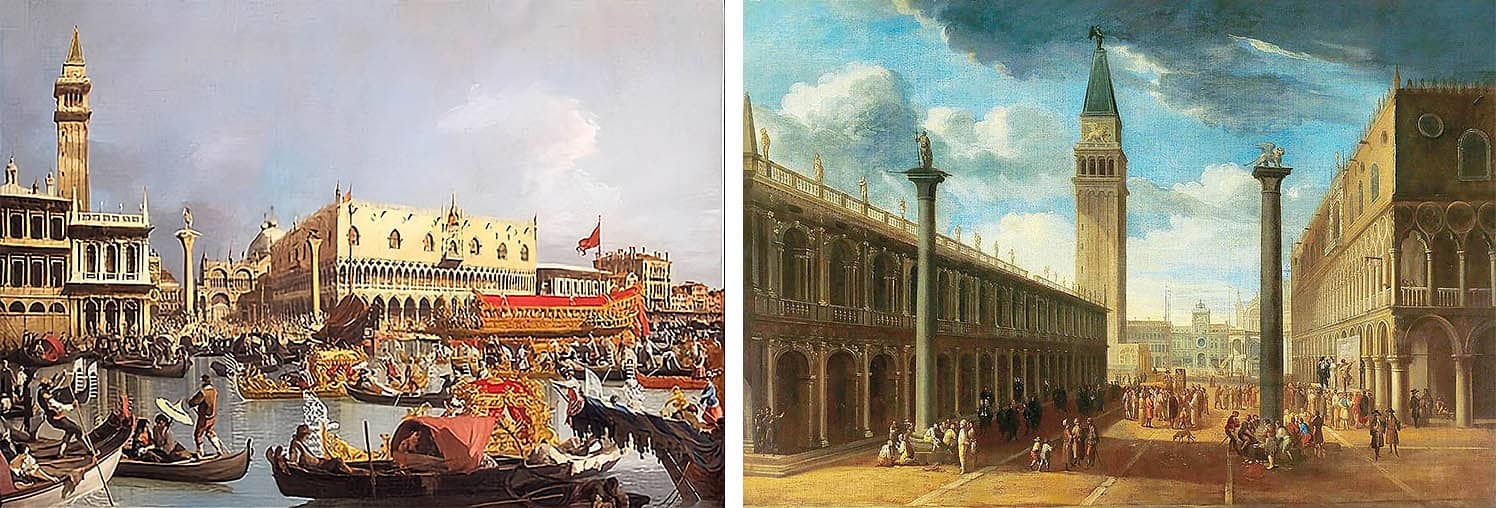
L. The Bucintoro by the Molo on Ascension Day. (1729-1730) Giovanni Antonio Canal – R. “A view of the Piazza San Marco looking north from the Piazzetta towards the clock tower Venice” Luca Carlevarijs c.1703.
Columns as Thresholds and Civic Symbols
The Columns of San Teodoro of Amasea and the Winged Lion of San Marco, are two prominent columns situated in Piazzetta San Marco in Venice, and each is topped with a statue of the first (ST – up to the 9th C) and second (SM) patron saint of Venice. They were brought in from the East and likely erected between 1172 and 1177, and are made of pink and gray marble and granite.
St. Mark has been considered as Venice’s patron saint from the time his remains were stolen from a tomb in Alexandria by two merchants, and was brought to Venice in 828 AD. Over time, the city of Venice had developed and prospered and it was decided that a more esteemed saint was required. Hence, St. Mark was interned in the Basilica, enlarged by the addition of a chapel dedicated to his name, and thus became the patron saint of Venice. His representation as a winged lion became the symbol of the lagoon city.
They form the ceremonial gateway to the city – not merely decorative, but functioned as a symbolic threshold between sea and state, announcing Venice’s authority to all who arrived by water. Their placement at the Molo, the city’s principal landing point, reinforced Venice’s self-image as a maritime republic, whose power flowed from the sea rather than the land. The columns thus became visual shorthand for sovereignty, justice, and divine protection, anchoring the political mythology of Venice in stone.
Legend tells that three monolithic columns started from the East and were brought to Venice by sea with three ships, one of which, in an attempt to land it on the shore, sank in the lagoon. The other two were lying on the shore and remained there for over a hundred years. Thanks to the ingenuity of the semi-legendary Nicolò Barattieri, the columns were lifted and set into their current elegant arrangement in Piazzetta San Marco.
During the Middle Ages and Renaissance, small wooden shops stood beneath the columns, and subsequently, executions were carried out between the two columns. From this custom comes a Venetian saying: “Te fasso veder mi, che ora che xe“ (I’ll show you what time it is), referring to the fact that convicts, with their backs to the Basin of San Marco, would see the Clock Tower as the last thing before execution.
Classical Memory and Republican Identity
Venetian columns also reflect a conscious engagement with classical Rome. During the Renaissance, Venice cultivated an image of itself as a successor to Roman republican virtue, distinct from the feudal monarchies of Europe. Columns, especially those inspired by classical orders; were integral to this visual language. In palaces, churches, and public buildings, colonnades evoked stability, order, and civic harmony. Unlike Rome, however, Venice adapted classical forms to its unique environment, often favouring lighter proportions and decorative capitals that blended Byzantine, Gothic, and Islamic influences. This hybridization mirrored Venice’s political identity: rooted in classical ideals, yet shaped by centuries of trade and cultural exchange across the Mediterranean.
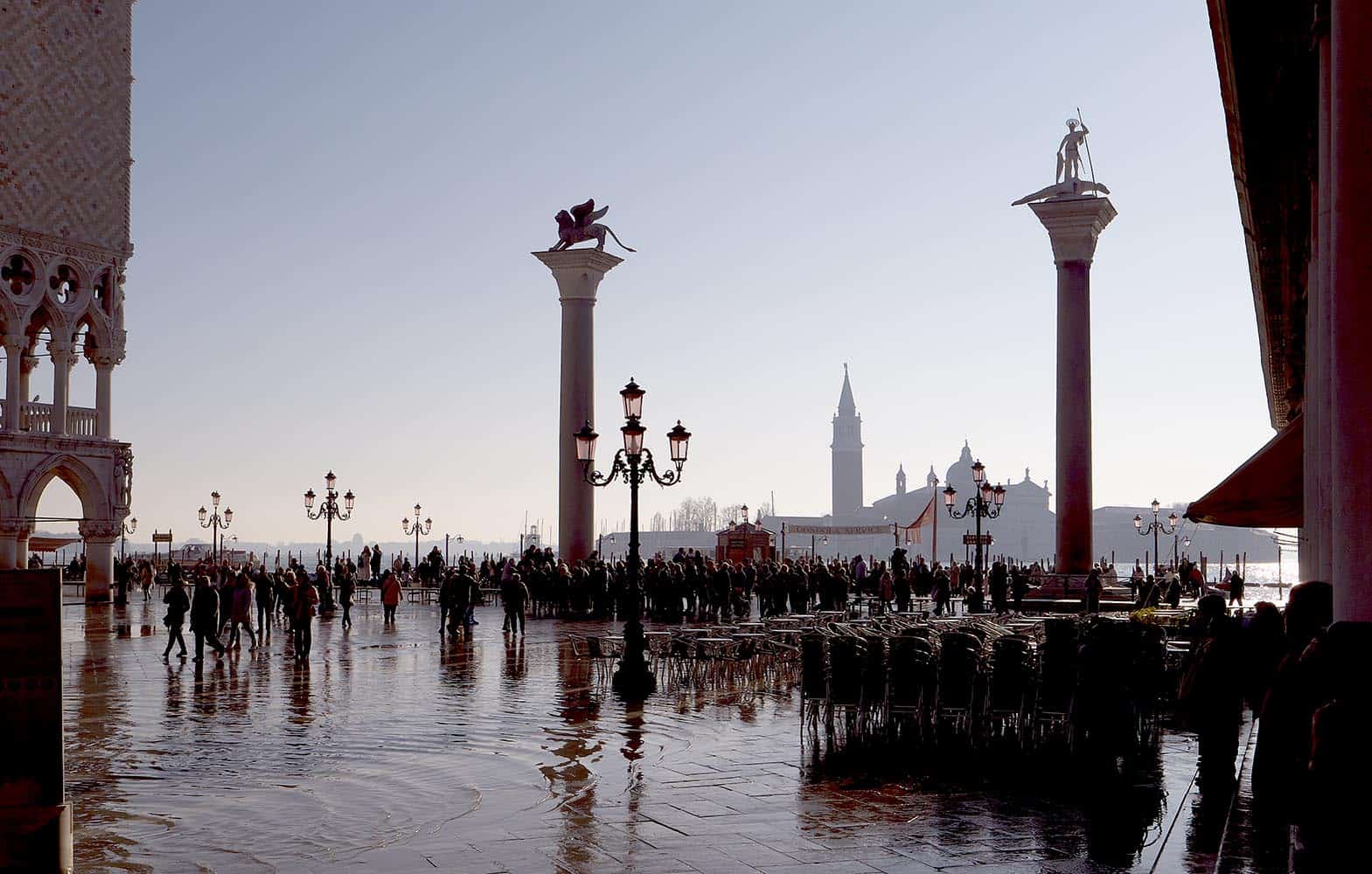
Piazzetta San Marco during Acqua alta. The two columns of the Winged Lion of San Marco and San Theodoro.
Columns and the Ritual Life of the City
Columns in Venice also structured public ritual and social memory. The space between the two columns in the Piazzetta, for example, was historically used for public executions; embedding the columns within the city’s system of justice and spectacle. Over time, this association became so strong that Venetians avoided walking between them, a superstition that persists today. In this way, columns functioned as silent witnesses to civic life, absorbing layers of meaning through repeated use and collective memory. They marked not only architectural space but moral and emotional boundaries within the urban fabric.
Shakespeare and the Architecture of Law. Although Shakespeare’s “The Merchant of Venice” never describes the Piazzetta columns directly, the play’s Venetian setting draws heavily on the city’s reputation for legal spectacle. Renaissance audiences associated Venice with public trials, rigid statutes, and ceremonial justice, all of which were spatially anchored in monumental architecture. Columns, in this context, function symbolically as supports of the legal order – upright, inflexible, and exposed to public scrutiny. The trial scene echoes the logic of Venetian justice: law performed before an audience, where mercy and rigidity contend under the gaze of the state. Scholars have long noted that Venice’s legal culture was inseparable from its architecture, which made justice visible and theatrical rather than abstract.
Verticality in a Horizontal City
In a city defined by water and low horizons, columns provide moments of vertical emphasis. Rising from quays, porticoes, and façades, they punctuate Venice’s otherwise horizontal landscape, guiding the eye upward and lending rhythm to streets and squares. This verticality carries symbolic weight: columns suggest endurance and aspiration in a city perpetually threatened by subsidence and decay. Their survival across centuries reinforces the idea of Venice as a place where art and order resist the erosive forces of time and tide.
Canaletto: Columns as Stage Architecture – Spectacle and Ceremony
In the paintings of Canaletto (1697-1768), columns serve a different but equally significant role. His vedute of the Piazzetta and the Molo repeatedly frame the twin columns of Saint Mark and Saint Theodore, using them as compositional anchors. These columns transform Venice into a theatrical space, a city consciously staged for spectacle and ceremony. Canaletto’s precise rendering emphasizes their clarity and order, reinforcing Venice’s image as a rational, harmonious republic. At the same time, their repetition across his works helped fix them in the European imagination as emblems of Venice itself, recognizable symbols that condensed the city’s identity into a single architectural gesture.
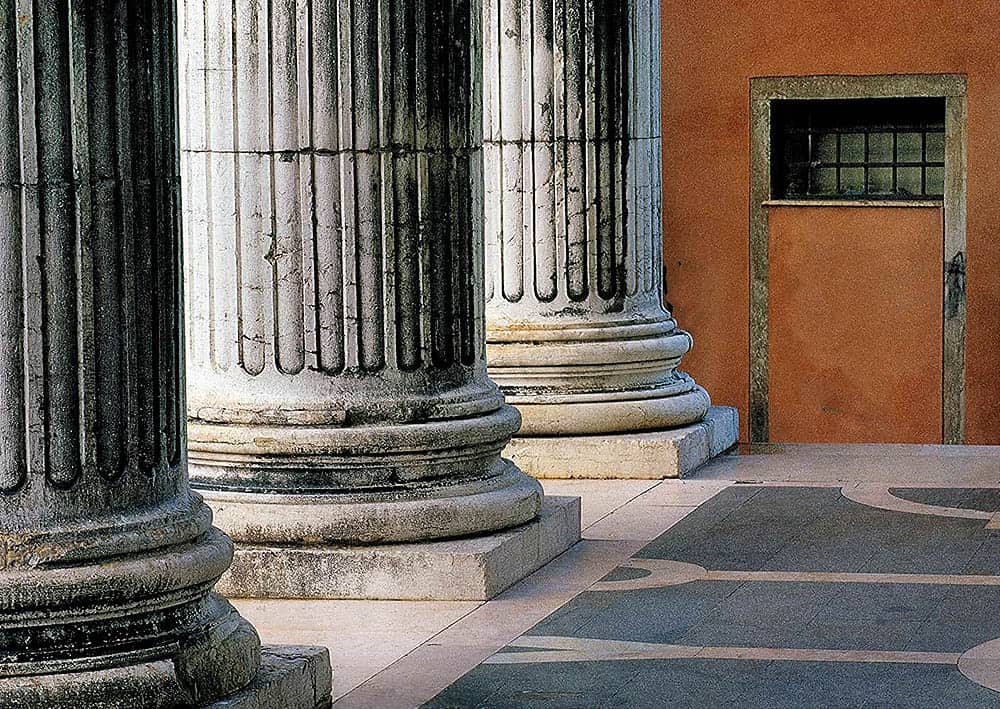
The massive columns of San Nicolo da Tolentino, just a few minutes walk to the east of Piazzale Roma Bus Terminal.
The Castellani and Nicolotti. were the two rival factions, into which the working class of Venice was divided. Like modern gangs, they could be identified by their “colours”: the Nicolotti (centred around San Nicolo da Tolentino above), wore black caps and scarves; whilst the Castellani (based around the Arsenale. Castello) wore red. The Authorities apparently allowed this tradition to keep their population “fighting-fit”. It allowed working class people to “blow of steam” and not challenge the state by uprisings. A fascinating post!
Exploring the changing symbolism in 19th-century travel writing
In nineteenth‑century travel writing, Venetian columns underwent a decisive symbolic shift. Where earlier literature treated them primarily as instruments of justice and civic spectacle, Romantic and Victorian writers, most notably John Ruskin and Joseph Brodsky; recast them as moral witnesses, charged with ethical meaning and historical judgment. Columns no longer simply stage power; they testify to its rise, corruption, and decline.
From Civic Authority to Moral Evidence
By the early nineteenth century, following the fall of the Republic, Venice had lost its political independence, which profoundly altered how visitors interpreted its architecture. Travel writers approached the city not as a living republic but as a moral ruin, and columns became key evidence in this reading. Once symbols of upright law and public order, they were now seen as eroded, leaning, or repurposed – physical signs of a civilization that had outlived its ethical foundations. The column’s verticality, formerly associated with justice and stability, became a poignant contrast to the city’s political collapse.
Ruskin’s Ethical Architecture
For John Ruskin, columns were never neutral forms. In The Stones of Venice, he argued that architecture embodied the moral condition of the society that produced it. Venetian columns, especially those of the Gothic period, represented for him a moment when craftsmanship, faith, and civic responsibility were aligned. Their irregular capitals and hand carved details testified to the dignity of individual labour and spiritual freedom. Classical columns, by contrast – particularly those of later Renaissance buildings; signalled moral decline.
Their mechanical symmetry and imitation of antiquity reflected, in Ruskin’s view, a society that valued display over truth and authority over conscience.
His Venice is thus read vertically: columns rise as moral barometers. Where they are expressive and varied, society is healthy; where they are rigid and formulaic, corruption has set in. This moralized reading transforms columns from supports of spectacle into ethical documents, capable of condemning the very power they once upheld.
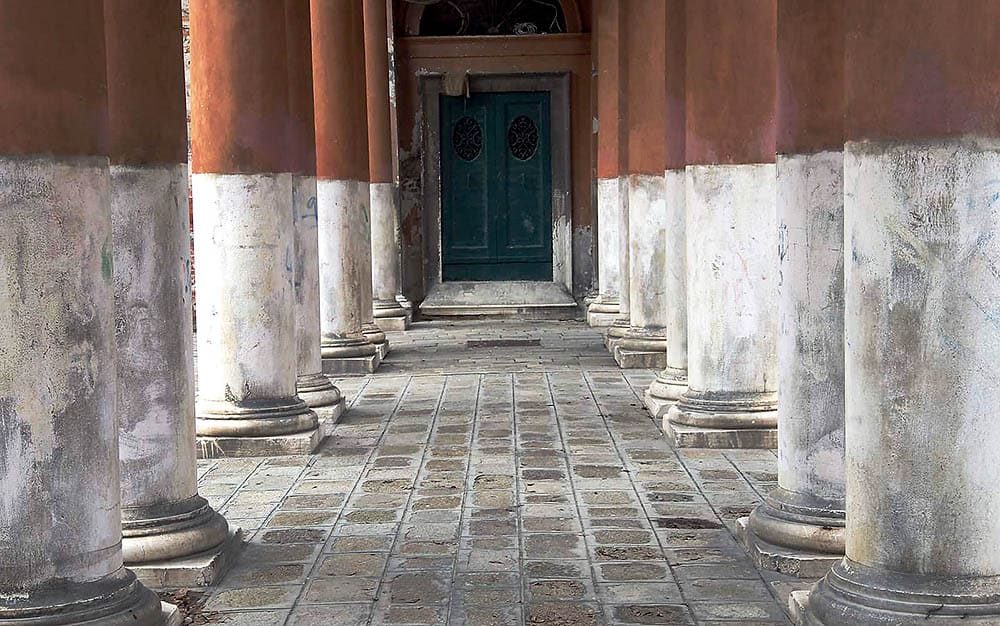
Impressive red ochre and white columns, framing an entrance to the Palazzo Grimaldi o della Nunziatura, NW Castello and next to impressive church of San Francesco della Vigna.
Spectacle Reinterpreted as Moral Failure
Nineteenth century travel writers also reinterpret the spectacle once associated with Venetian columns. Public executions, proclamations, and ceremonies, that were formerly signs of civic transparency; are reframed as evidence of cruelty or decadence. The Piazzetta columns, once gateways of justice, become haunting reminders of state violence performed for entertainment. Writers linger on their weathered surfaces, reading erosion as a form of historical judgment. Spectacle, in this context, is no longer glorious but morally suspect, and columns stand as mute accusers rather than celebratory monuments.
The Column as Ruin and Warning
This shift culminates in a broader Romantic sensibility that treats Venetian columns as ruins in slow motion. Unlike fallen Roman columns, Venice’s still stand, but their endurance is uneasy. Travel writers emphasize their precarious foundations in water, turning them into metaphors for civilizations built on unstable moral ground. The column’s survival becomes ironic: it outlasts the values it once represented. In this way, nineteenth century literature transforms Venetian columns into warnings -architectural reminders that power without ethical integrity ultimately hollows itself out.
Joseph Brodsky, writing as an exile in Watermark, approached Venetian columns with a more introspective sensibility. For him, columns were mnemonic devices – vertical lines anchoring memory in a city defined by flux. He often lingered on their tactile presence: cold stone, eroded bases, capitals softened by salt air. Columns offered a sense of permanence in a place where water constantly threatens to erase boundaries. Brodsky’s Venice is a city of pauses and reflections, and columns function as moments of stillness, allowing the observer to measure personal time against historical duration. They become companions to solitude, standing silently as witnesses to centuries of arrivals and departures.
Cultural Legacy and Enduring Meaning
Ruskin’s moralized vision profoundly shaped how later generations perceived Venice. His reading of columns as ethical indicators influenced preservation movements and modern literary responses, including Brodsky’s more introspective meditations on endurance and loss.
What unites these interpretations is the recognition that Venetian columns mediate between permanence and change. Whether read morally, poetically, or pictorially, they stand at the intersection of stone and water, history and perception. Columns in Venice are never merely vertical supports; they are instruments of meaning, shaping how the city is seen, remembered, and judged across centuries.
The nineteenth century thus marks a turning point: columns cease to be stages for justice and become judges of history, measuring human ambition against time, decay, and conscience.
Today, Venetian columns continue to shape the city’s cultural identity. They appear in paintings, literature, and photography as emblems of Venice’s grandeur and fragility. For visitors, they frame iconic views; for Venetians, they remain part of a living urban language that connects present experience with historical memory. The significance of columns in Venice lies not only in their form but in their ability to condense complex ideas – power, faith, justice, and continuity; into enduring architectural gestures.
A poem in celebration of “The Two Columns of San Marco and San Teodoro”
Two columns rise where sea‑winds roam,
San Marco and San Teodoro guard their home;
the Piazzetta opens like a gate,
a threshold held between the tides and fate.
The lion stands with wings of burnished gold,
a silent prophecy the centuries uphold;
its gaze keeps watch on every ship that nears,
a calm that’s carved from triumphs, doubts, and fears.
Beside him, Theodore with dragon slain
rests lightly, soldier‑still, above the plain;
his poise suggests that beauty must be earned,
that every peace is from a struggle turned.
At dusk their shadows stretch across the square,
two ancient thoughts suspended in the air –
one born of faith, one tempered into might,
together framing Venice in the light.
And all who pass between them feel the claim:
to carry both the lion’s steady flame
and saintly courage as the waters gleam –
for Venice lives in those who dare to dream.
Links (internal–external)
The Literature of Venice. This major series of post, dives deeper into literary works about Venice; focusing on how each chosen author tackles common themes and highlighting their most illuminating quotes about the city. While many reflect a different era in Venice’s history, they still provide descriptions, insights, and even recommendations that remain relevant today.
Introductory post: The Literature of Venice
Henry James and the Allure of Venice
Death in Venice by Thomas Mann
Ernest Hemingway’s Love for Venice
Joseph Brodsky’s Love for Venice
The St Mark’s Square Guide is divided into two main sections: 1. Introduction – Where to start – Getting there and around – Discount passes for main attractions and waterbus transport – Gondola rides. 2. A comprehensive list of all the top attractions of St Mark’s Square, including three detailed walks. St Mark’s Square Guide
This post will guide you through the finest high viewpoints in the historic heart of Venice, each providing a distinct view of the city. It contains all the necessary information and links, along with a selection of my pertinent posts, to enrich your exploration of this enchanting city. They all offer new perspectives on the city, as well as a truly memorable experience. Best High Views in Venice
The Lion of St Mark. Representing Mark the Evangelist, in the form of a winged lion holding a Bible; it is the symbol of the city of Venice and formerly of the Venetian Republic. The Lion of St Mark
Most visitors to Venice will admire, the Column Capitals of the Doge’s Palace; in the Piazzetta di San Marco; without understanding the narrative behind them. There are an overwhelming number of images to take in. However, it is worth spending time admiring them, because few visitors will understand the fascinating story and symbolism they represent – essentially a “book in stone” Doge’s Palace – Column Capitals
For a more detailed analysis about the origins of statues of San Marco and San Teodoro on top of the two columns: The Two Columns of the Piazzetta San Marco in Venice
VIDEO 7 mins: VENICE: St Mark’s Square / Piazza San Marco
The Columns of Venice The Columns of Venice The Columns of Venice The Columns of Venice