
Friedrich Nerly and Venice
Friedrich Nerly and Venice. Discover the 19th century German artist, who merged North European Romanticism with the beauty of the lagoon city.
Making Venice his home, he became one of the most evocative interpreters of the city’s atmosphere. Nerly’s work bridges Northern European Romanticism with Venice’s distinctive light, architecture, and lagoon vistas, creating a visual language that feels both poetic and precise. By settling in Venice and immersing himself in its rhythms, Nerly transformed the city’s shifting skies and reflective waters into a body of work that continues to shape how viewers imagine Venice today.
Friedrich Nerly occupies a distinct and important place in the history of 19th-century European art.
This post covers:
- Early Life and Artistic Awakening in Germany
- Rome and Early Influences
- The Move to Venice: A Lifelong Muse
- Capturing the Soul of Venice: Style and Technique
- Later Life and Legacy
- A Poem to celebrate “The Man Who Followed Light“
- Links (internal–external)
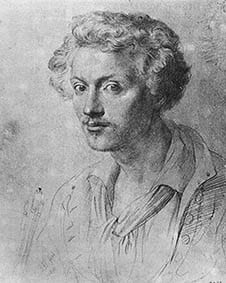 Self-portrait 1828
“Venice and always Venice, from all sides, large and small, in ancient and modern times.”
Friedrich Nerly, 1845. Writing about his everyday artistic life, at a point when he had already been living in the lagoon city for seven years.
(Note. He is sometimes referred to as “The Elder”, to distinguish him from his son, the painter Friedrich Paul Nerly. His first name can also be seen as “Federico” and “Federigo”.)
Friedrich Nerly and Venice Friedrich Nerly and Venice Friedrich Nerly and Venice Friedrich Nerly and Venice
Early Life and Artistic Awakening in Germany
Nerly’s journey into the world of art began under challenging circumstances. Born Christian Friedrich Wilhelm Nehrlich in Erfurt, Thuringia, Germany, in 1807, he later adopted the Italianized surname “Nerly” upon settling in Venice, the city that would become his lifelong muse and the subject of his most iconic works.
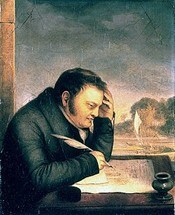 Portrait of C. F. von Rumohr
Friedrich grew up in a family of limited means, as his father worked as a post office official in Erfurt, and experienced hardship early on when his father died prematurely. His relatives, especially his uncle Heinrich Joachim Dewitz, a Hamburg musician, took over his upbringing. Moving to Hamburg was key, as Nerly’s artistic talent was noticed there and he received formal training.
His most crucial early influence was the Baron Carl Friedrich von Rumohr, a multifaceted figure known not only as a landowner and gastronome, but also as a significant art historian, writer, and patron. Around 1823, Nerly became a protégé, essentially an apprentice in his circle; refining his abilities in both drawing and painting.
He assimilated influential trends from North German art and likely interacted with local artists; however, Rumohr’s main role was to foster his artistic growth through careful study of nature and appreciation of classical art and the subsequent focus on landscape. His support and connections, helped him pursue opportunities in Italy.
Rome and Early Influences
The dream of Italy, considered a near-obligatory pilgrimage for Northern European artists since the Renaissance, became a reality. During 1827-1828, he embarked on the journey south in the company of his mentor, Baron von Rumohr.
Nerly’s Italian Journey marked a pivotal period in his artistic development, offering exposure to landscapes, lighting, and cultural heritage that had motivated many predecessors. During their travels, the group passed through several regions of Germany, notably Weimar, where they may have interacted with intellectual circles linked to Goethe, before proceeding across the Alps.
The principal destination was Rome. Upon arrival in the city, Nerly became involved in an active international artistic community, particularly among the German-speaking artists referred to as the Deutschrömer. He soon took over managing the “Cervaro Festival” for the Deutscher Künstlerverein (German Artists’ Association) of Rome. He would hold that position until his departure in 1835.
Rome served as a dynamic center for emerging artistic concepts. Nerly engaged with prominent representatives of German Neoclassicism and Romanticism residing there, including landscape painters Joseph Anton Koch and Johann Christian Reinhart, renowned for their heroic portrayals of the Roman Campagna. He may also have encountered individuals from the Nazarene movement such as Friedrich Overbeck, although Nerly’s artistic trajectory diverged from the movement’s religious and historical emphasis.
While in Rome, Nerly concentrated on examining the city’s ancient ruins and the adjacent countryside, particularly the Campagna. He produced numerous sketches, documenting the distinctive light and ambiance of central Italy. Works from this era, including “The Villa of Tivoli” and the “Temple of Vesta and Ceres”, reflect his advancing proficiency in landscape composition and his assimilation of the Italianate style.
Drawing upon established methods of depicting notable sites, Nerly gradually incorporated a personal, Romantic perspective characterized by attention to mood and the interplay of light. The influence of French artists working in Rome, such as Camille Corot, who similarly pursued plein-air sketching and atmospheric effects; contributed further to the artistic environment he experienced.
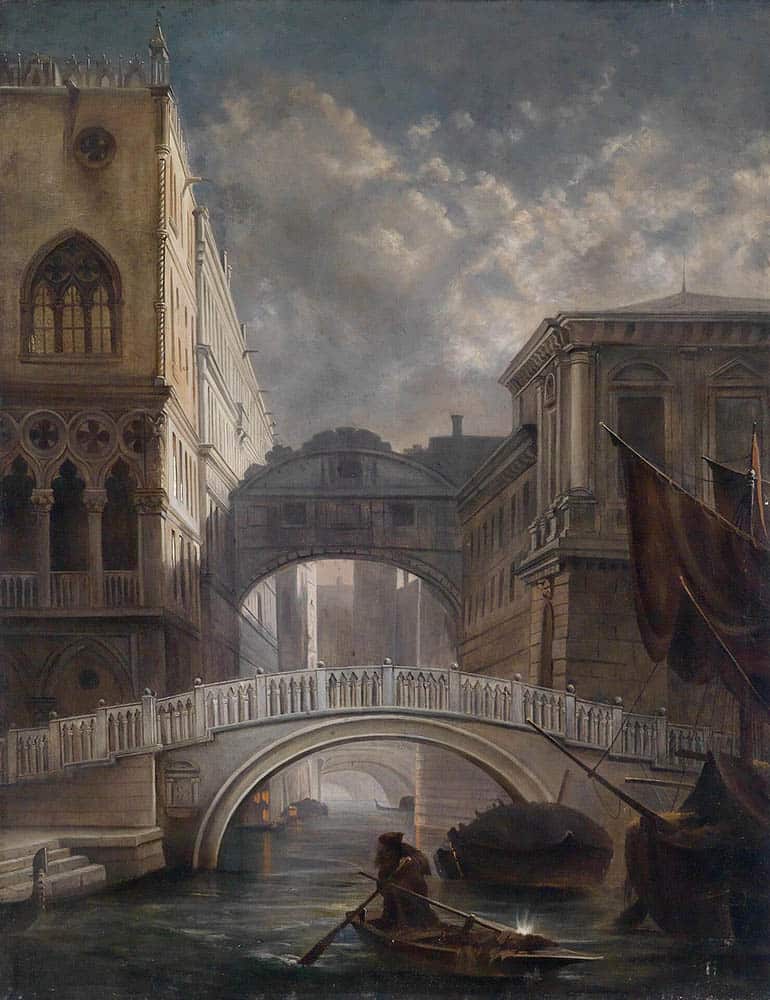
Friedrich Nerly. Seufzerbrücke (Bridge of Sighs) ?date.
The Move to Venice: A Lifelong Muse. Friedrich Nerly and Venice
Rome provided Nerly with valuable experience, but Venice turned out to be his genuine artistic home. Following several years spent in Rome and southern Italy, he settled permanently in Venice in 1835, adopting the Italianized name Nerly and establishing himself as a prominent foreign artist for many years. This was a period when the city had already become a magnet for artists, writers, and travellers; seeking inspiration in its fading splendour. His centrally located studio in the Palazzo Pisani became a popular destination for many travellers.
Unlike many painters who treated Venice as a picturesque curiosity, Nerly approached it as a lived environment. Absorbing the rhythms of daily life and the subtle transformations of light across canals and façades and his intimacy with place; distinguishes his work from the more theatrical or idealized Venetian scenes popular among visiting artists.
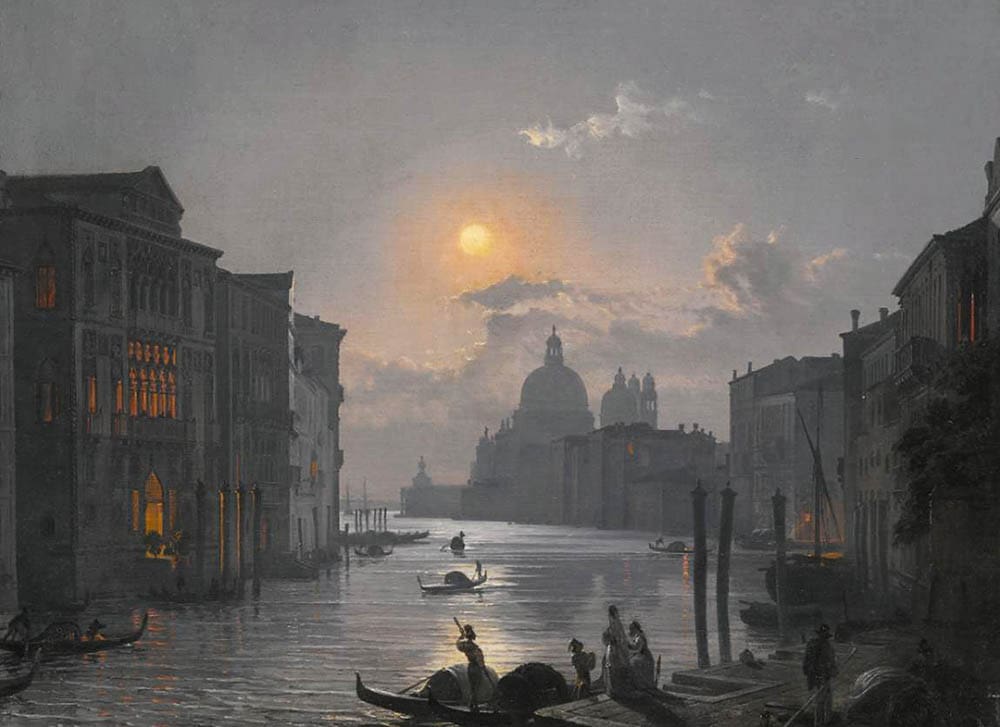
Friedrich Nerly. Venice, A View Of The Grand Canal With The Palazzo Cavalli-Franchetti And Santa Maria Della Salute (?date)
There were likely multiple factors influencing the choice of Venice:
The city presents a distinct visual environment, with a landscape built upon water, distinguished by reflective surfaces, striking architecture, and the dynamic interplay of light and atmosphere. For a landscape artist with a growing interest in atmospheric effects, Venice provided a wealth of inspiration.
Additionally, Venice’s status as a key destination on the Grand Tour attracted affluent visitors from Europe and America, thereby ensuring a steady demand for high-quality vedute of its renowned landmarks.
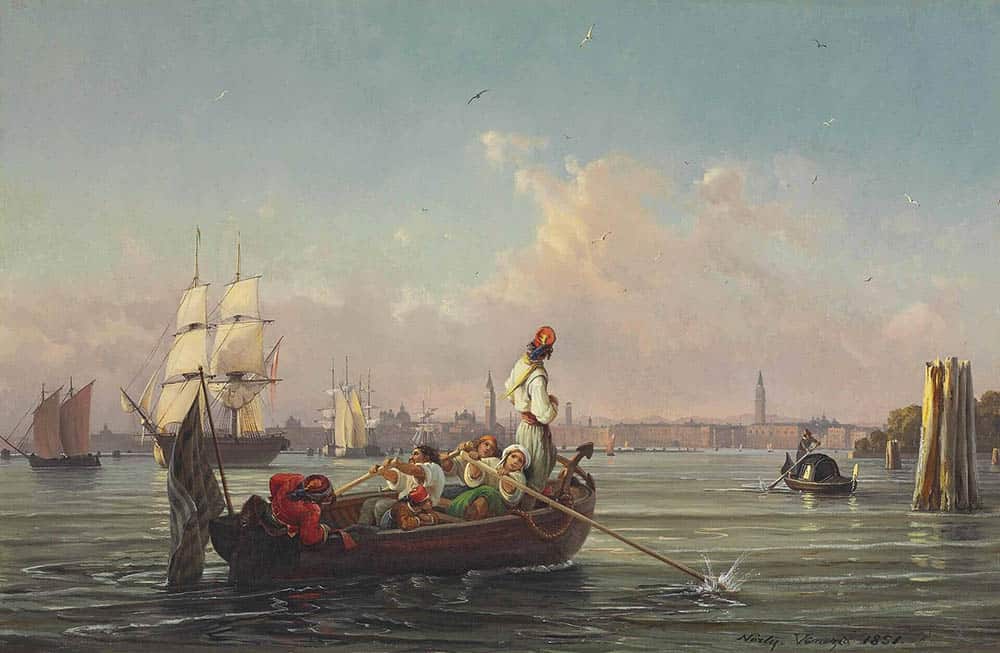
Friedrich Nerly – In der Lagune, Venedig (1851)
Nerly quickly gained recognition within Venice’s artistic community, establishing a studio and producing the cityscapes that would become synonymous with his work. His decision to remain in Venice, rather than return to Germany or continue his travels, reflected a profound personal and professional commitment to the city.
In 1840, he married Agathe Alginovich (1810–89), adoptive daughter of the Marchese Maruzzi, and they had one son, Friedrich Paul, who also became a painter.
Later in 1852, King William I of Württemberg awarded him the Knight’s Cross in the Order of the Crown, which gave him the right to use the noble prefix “von”.
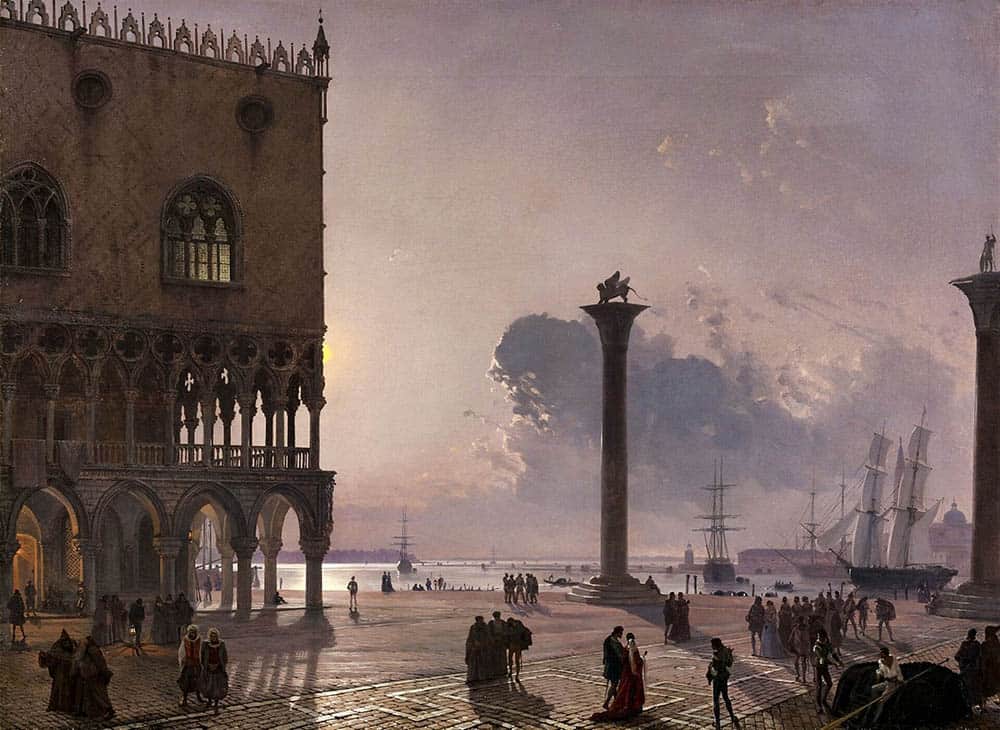
Friedrich Nerly – Piazzetta di San Marco bei Mondschein (1849).
Capturing the Soul of Venice: Style and Technique. Friedrich Nerly and Venice
Friedrich Nerly’s art is firmly rooted in German Romanticism, but Romanticism, as a broad movement, emphasized emotion, individualism, the power of nature, and often a fascination with the past and the non-native. Caspar David Friedrich (1774–1840) was the central influential figure of German Romanticism. While there is no evidence they met, Nerly’s Venetian moonlights and sunsets echo Friedrich’s metaphysical approach; though Nerly remained more topographical and less symbolic.
His long residency in Venice gave his work a unique character. Channelling these sensibilities into his depictions of Venice, he absorbed the rhythms of daily life and the subtle transformations of light across canals and façades.
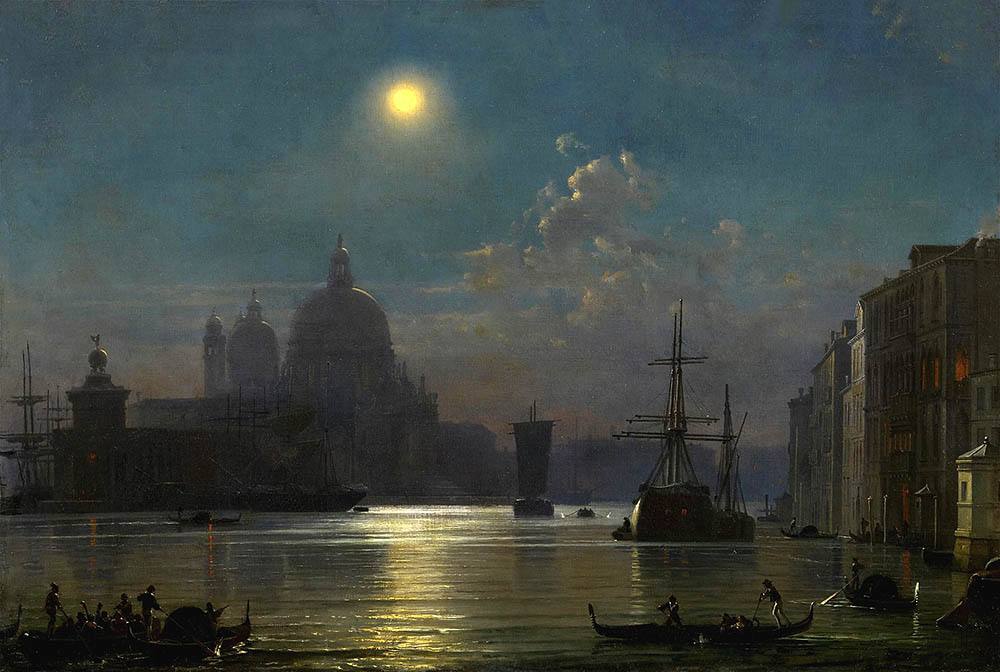
Friedrich Nerly. Venice. View over the San Marco basin of Santa Maria della Salute. (1855)
While he painted topographical views, his more intimate approach differed significantly from the earlier, more objective vedute tradition exemplified by artists like Canaletto and Francesco Guardi in the 18th century.
Nerly focused on conveying Venice’s atmosphere, especially at dusk and during unique weather conditionns. His most acclaimed works feature night scenes and sunsets. He skillfully captured moonlight’s impact on Venice’s architecture and canals through nuanced tones and highlights. Nerly’s moonlit views of the Piazzetta di San Marco became famous, reproduced in many versions for clients. He combined careful observation with poetic insight, focusing on light’s effects on water, building reflections, and Venice’s humid air. His palette favoured warm sunset tones contrasted with cool blues and silvers in nocturnes.
J.M.W. Turner’s impact on Nerly is often considered, as both artists were drawn to Venice and the interplay of light and atmosphere. Although a direct connection is unclear, he was familiar with Turner’s work and pursued similar effects, but kept more topographical detail than Turner’s later, abstract pieces. Nerly also drew inspiration from painters like Louis Léopold Robert, evident in the genre elements and figures within his Venetian landscapes.
He was also contemporary with other prominent German landscape painters who worked in Italy, such as the Achenbach brothers, Andreas Achenbach and Oswald Achenbach – leading figures of the Düsseldorf school known for their dramatic seascapes and Italian scenes. Carl Blechen, another important German Romantic landscape painter, also travelled to Italy and shared an interest in capturing atmospheric effects and architectural subjects, though with a distinct style.
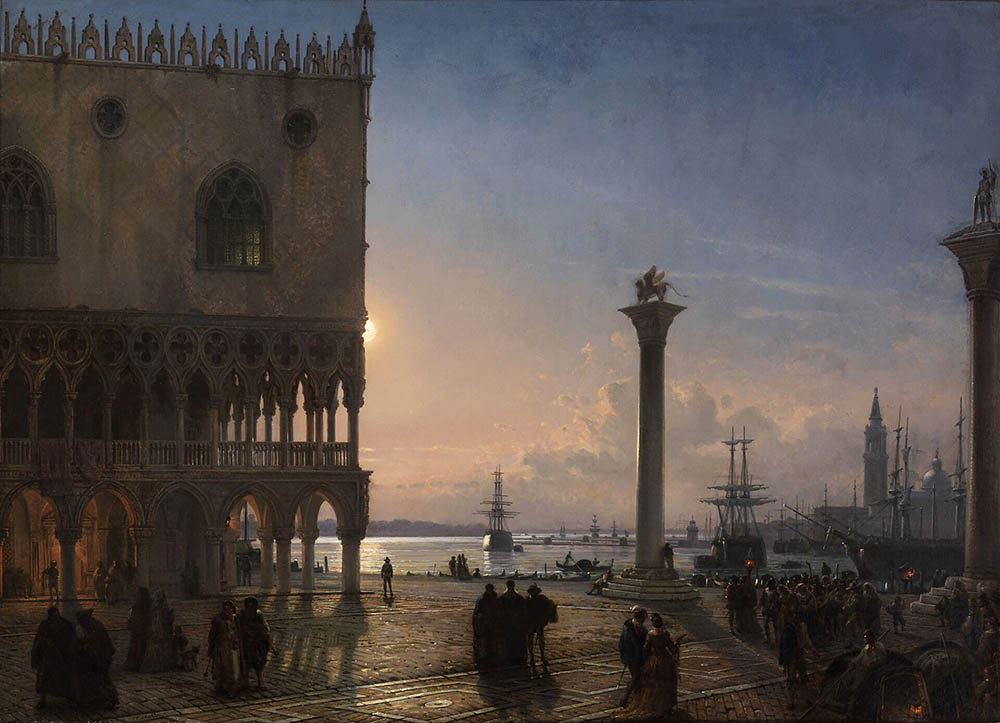
Friedrich Nerly – Piazza San Marco in Venedig bei Mondlicht (1871)
Later Life and Legacy
Nerly stayed active in Venice, painting Venetian scenes with his Romantic style with his studio attracting art enthusiasts. He died in Venice on October 21, 1878, having spent the majority of his life in his adopted city. His son, Friedrich Paul Nerly, carried on the family’s artistic tradition in Venice. He is buried in the Protestant section of the San Michele cemetery, Venice.
His death ended a notable period for German Romantic painting in Italy, but his legacy was well preserved. In 1883, his entire art collection was donated to the city of Erfurt by his son, Friedrich, with the stipulation that it be used to create a museum. This was carried out and the Angermuseum opened in 1886. (Anger is German for “town commons”). Also a street in Erfurt is named after him.
Today, the museum holds the most significant Nerly collection, offering insights into his development and supporting research on 19th-century landscape painting.
In assessing Friedrich Nerly’s Venetian art, one encounters a painter deeply attuned to place, atmosphere, and the quiet poetry of everyday scenes. His works stand as meditations on Venice itself – a city of reflections, silences, and the lingering beauty. Through his sensitive handling of light and space, Nerly invites viewers not merely to observe Venice, but to inhabit it, experiencing its subtle moods and enduring melancholy. His paintings resonated deeply with the sensibilities of his time and continue to captivate viewers today.
A Poem to celebrate “The Man Who Followed Light”
He left the northern towns where winter ruled the air,
Where skies were stern and colour seldom dared appear;
A restless youth who felt the world was wide and bright,
And somewhere far beyond the Alps there lived a truer light.
Rome met him first with ruins whispering through the dust,
Old stones that taught him patience, discipline, and trust;
Yet even as he sketched the arches worn and grand,
He sensed another calling from a more enchanted land.
For travellers spoke softly of a city built on tide,
Where every street was water and the moon became a guide;
A place where dusk descended like a blessing on the stone,
And beauty moved in silence, needing neither crown nor throne.
So Nerly journeyed northward with a pilgrim’s quiet aim,
To find the fabled Venice and to learn her secret flame;
And when he reached the lagoon’s edge at the fall of day,
He knew at once his wandering heart had found its final stay.
The city rose before him like a dream half‑told,
Its domes dissolving gently into evening’s molten gold;
The water breathed around him with a slow, eternal grace,
As if the world had paused to let him truly see this place.
He walked the narrow calli where the shadows bend and lean,
Where lanterns cast their trembling halos on the green;
He learned the tides’ soft language, how the currents speak,
How fog can make a palace seem both ancient and unique.
And so he painted Venice not as others claimed to see –
Not carnival nor splendour nor a stage for pageantry;
But Venice in her quiet moods, her solitude and sighs,
The poetry that gathers in her ever‑changing skies.
He chased the moon across the water’s silver skin,
He caught the hush of dawn before the day could begin;
He traced the drifting vapours as they curled along the quay,
And found in every shifting cloud a new philosophy.
Years passed like tides returning, steady, soft, and sure,
And Nerly’s love for Venice only deepened, grown more pure;
He lived as though the city were a pulse beneath his hand,
A fragile, breathing miracle he struggled to understand.
But storms would sometimes gather with a violence of their own,
And Venice, fierce and ancient, showed the strength of weathered stone;
He painted those dark tempests too, the thunder’s jagged roar,
For beauty lives in shadows just as much as on the shore.
At last, when age grew heavy and his wandering was done,
He asked to rest in Venice, where his life and art were one;
And so on San Michele, where the waters softly part,
He lies among the dreamers with the lagoon against his heart.
Yet still, when night descends and moonlight strokes the sea,
The city glows with something like his old serenity;
For Nerly’s gaze remains there, woven through each view –
A man who followed light, and found a world made new.
Links (internal–external)
More Foreign Artists working in Venice:
John Ruskin – Writer and Artist
15-16th Century The Venetian School of Art
18th Century Art. Introduction to 14 posts of the most signiificant artists of that period. Venetian Artists-18th Century (Introduction)
Angermuseum Erfurt | Kunstmuseen Erfurt
YouTube Video 2.55 mins: Friedrich Nerly’s Stunning Scenes
Friedrich Nerly and Venice Friedrich Nerly and Venice Friedrich Nerly and Venice Friedrich Nerly and Venice